
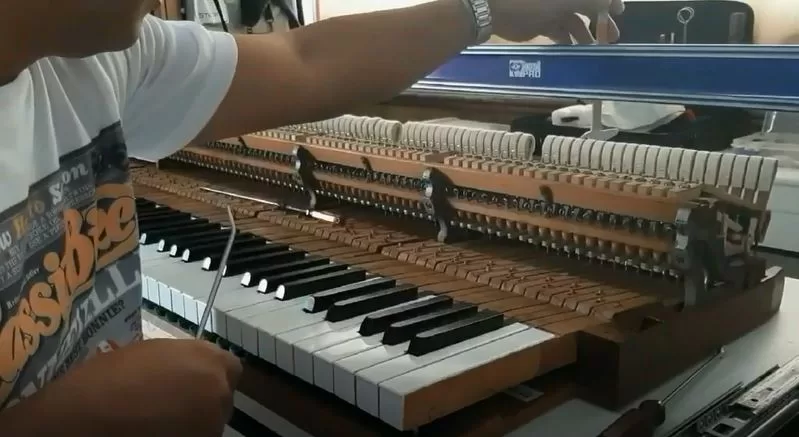
If your piano has not been professionally maintained for many years, the action—the complex mechanical system that translates your touch into sound—will almost certainly be compromised. Even if the piano still plays, hidden wear and aging materials can limit performance, consistency, and reliability. Reconditioning and regulation can certainly restore the piano’s action precision and responsiveness, allowing the instrument to perform as it was designed to.
What Is the Piano Action?
The piano action also consists of thousands of moving parts: hammers, shanks, flanges, key bushings, repetition levers, springs, and felt components. Every time you press a key, these parts must work together with exact timing and minimal friction. Over years of use—and even years of non-use—this system gradually deteriorates.
What happens when someone does not maintain a piano?
When regular regulation and servicing are neglected, several issues develop:
- Felt compression and wear – Felts harden, flatten, or become uneven, reducing control and tonal consistency.
- Increased friction – Bushings tighten or loosen with humidity changes, also causing sluggish and uneven key movement.
- Loss of regulation – Key height, hammer travel, let-off, and repetition drift out of specification.
- Weakened springs and loose centers – The action becomes less reliable and slower to repeat notes.
- Inconsistent touch – Some keys feel heavy, others light, making musical control difficult.
These changes occur gradually, so many owners adapt without realizing how much performance has been lost.
Why Reconditioning & Regulation Is Necessary
Action reconditioning and regulation address system-wide wear, not just isolated problems. Spot repairs or tuning alone certainly cannot correct the underlying mechanical imbalance. Reconditioning restores the geometry, friction levels, and alignment of the action so all parts work together efficiently again.
This process may include:
- Replacing or easing key bushings
- Rebushing or repinning action centers
- Reshaping or replacing worn hammers
- Replacing worn felts and leathers
- Adjusting and balancing springs
- Full regulation of the action to factory or performance standards
Benefits of Action Reconditioning & Regulation
1. Improved Touch and Control
Keys respond evenly from bass to treble, allowing greater dynamic control and more accurate playing.
2. Faster Repetition
Notes repeat cleanly and reliably, which is essential for advanced repertoire and expressive playing.
3. Consistent Tone Production
Hammers strike the strings uniformly, improving tonal clarity and reducing harshness or unevenness.
4. Reduced Playing Fatigue
A properly balanced action requires less effort, making long practice sessions more comfortable.
5. Increased Reliability
This process also eliminates sticky keys, sluggish notes, and mechanical noise, restoring confidence in the instrument.
6. Extended Piano Life
Reconditioning prevents progressive wear that can otherwise lead to more expensive repairs later.
What to Expect After Reconditioning & Regulation
Pianists often describe the result as playing a different instrument—one that feels alive, responsive, and predictable. The pianist gains greater control of the piano at both soft and loud dynamics, improves articulation, and frees musical expression from mechanical shortcomings.
Is Reconditioning & Regulation Worth It?
For quality pianos that have not been serviced in many years, reconditioning and regulating the action dramatically improve performance. It also ranks among the most cost-effective solutions. It restores the instrument’s original potential without the expense of replacement, making it an essential investment for serious players, teachers, and institutions.
Conclusion
If your piano has gone years without proper maintenance, its action is almost certainly holding it back. Reconditioning and regulation correct the accumulated effects of time, wear, and environmental changes—bringing back precision, responsiveness, and musical enjoyment. It is certainly not merely maintenance; it is a restoration of how the piano should feel and sound.
Please contact us to learn more about reconditioning and regulation.